

Drentsche Aa National Park is a fascinating and unusual National Park in the northern Netherlands. With a gorgeous mixture of landscapes, Drentsche Aa National Park is centred on the Drentsche Aa stream and its surrounding drainage basin. It’s one of the most important National Parks in the Netherlands, but not for the reasons you might expect! Let’s have a closer look at this intriguing Drenthe national park.
TRIVIA:
❒ Official name: National Stream and Esdorp Landscape Drentsche Aa (Nationaal beek- en esdorpenlandschap Drentsche Aa)
❒ Established: 2002
❒ Size: 10600 ha
❒ Location: Drenthe
DISCLOSURE: This post contains affiliate links. If you make a purchase via one of those links, I will earn a commission at no extra cost for you.
About Drentsche Aa National Park
Drentsche Aa National Park is approximately 106 square kilometres in size and is located entirely within the province of Drenthe. Roughly triangular in shape, the northern tip is just a few kilometres from the city of Groningen, though the main visitor areas are towards the southern end, approximately 25-30 minutes’ drive from the city. The nearest large centre is Assen, which directly borders the south-western corner of the national park.

But while most national parks are important for their undisturbed environments, threatened habitats, or ecological importance, Drentsche Aa National Park is important mostly for cultural reasons. Humans have lived in the national park’s area for millennia, and there’s plenty of hunebeds (or hunebedden) (ancient tombstones) dotted around the landscape. But it’s actually the modern history of Drentsche Aa that’s more important. During the 19th and 20th centuries, when canals, dikes, reforestation, and land reclamation transformed the Dutch landscape, the Drentsche Aa region remained largely unchanged.

Today, Drentsche Aa (the winding stream which gives the national park its name) is considered one of the last waterways in the Netherlands that hasn’t been significantly altered by humans. It’s home to some of the few remaining examples of esdorp communities, a type of traditional Dutch farming village where farmhouses are built in a circle around the communal village green. These esdorpen first evolved during the Middle Ages but have since almost entirely disappeared from the landscape. Drentsche Aa really is an incredible place to visit, where you can engage with this important slice of history.
How to get to Drentsche Aa National Park
The park is located to the east of Assen, the capital of Drenthe Province. The park is easily accessible by car and you can even drive through it. Check out the map for the parking places around the park.
Read more: If you decide to stay longer in Drenthe, check out this 3-day itinerary in Drenthe.
Here are some distances to Assen from a few major cities in the Netherlands:
- Groningen – Assen: 30 km/30 min;
- Leeuwarden – Assen: 80 km/1 hr;
- Amsterdam – Assen: 175 km/2 hrs;
- Eindhoven – Assen: 230 km/2 hrs 20 min;
- Rotterdam – Assen: 225 km/2 hrs 20 min;
- Maastricht – Assen: 300 km/3 hrs 10 min.
Assen is also well-connected with public transport to the rest of the Netherlands. A trip from Amsterdam by train takes about 1 hr and 45 minutes.
Pro tip: Buy your train tickets online with the Dutch Railways (NS) for hassle-free travel. On the website of NS you can also check for any discounts.
Tip: Read this post about using the public transport in the Netherlands. It’s packed with tips that only a local knows!
Facilities in Drentsche Aa National Park
With 21 towns, villages, and hamlets within Drentsche Aa National Park, it’s really more of a living museum than a typical national park. As such, there isn’t a typical visitor information centre like at most national parks. However, the best starting point is at the Homanshof Information Centre, located in the esdorp of Anloo. Run by the State Forestry Service (Staatsbosbeheer), it’s located in an 18th century Saxon farmhouse and contains plenty of local and visitor information. There’s a tea shop in the adjacent barn for refreshments, while Anloo also has a couple of cafes if you’re after something more substantial.

You’ll also find an unmanned information centre near Balloo, at the parking lot near the entrance to the sheepfold, plus information posts are located at the Anloo, Deurze, and Wedbroeken park entrance gates.
Practical info: Bezoekerscentrum Homanshof
Address: Lunsenhof 20, 9467 PM Anloo
Opening times: April-October, from 9 am till 5 pm; November-March, from 10 am till 5 pm
Things to do at Drentsche Aa National Park
As a large park with a fascinating history, there’s plenty to see and do at Drentsche Aa National Park. So, whether it’s exploring history or immersing in nature, let’s check out the highlights.
Important: It’s not allowed to go out in a boat or sail in the creeks of the Drentsche Aa because of the fragile landscape.
1. Experience the esdorpen
The traditional esdorp communities are the main reason that Drentsche Aa is a national park, so any visit to the area wouldn’t be complete without experiencing at least one esdorp. There’s plenty of great ones to visit, but the highlight villages here are definitely Anloo, Balloo, Eext, and Taarlo.

Be sure to note the historic Saxon farmhouses arranged around the village green, the oak and ash trees used as important landmarks, and the incredible churches too – Sint-Magnuskerk in Anloo dates to 1100, while Jacobuskerk in Rolde is from the early 15th century. It wouldn’t be a proper Dutch community without beautiful windmills, and of course you’ll find 19th century mills at Oudemolen, and in Rolde as well.

2. Explore the ancient past
As a largely unmodified landscape, Drentsche Aa is an excellent place for ancient history buffs to explore this superb area. The entire park is dotted with ancient hunebedden (tombstones), also called dolmens (burial mounds), and even prehistoric cart trails as well, so any moderate hike or bike ride will encounter several of these.
Here you can find a complete map of all hunebedden in the Netherlands:

In the town of Assen, just across the park’s border to the south-west, Drents Museum is home to several exhibitions about ancient geology, prehistoric animals, and the area’s first inhabitants too, so it’s well worth a look.
Practical info: Drents Museum
Address: Brink 1, 9401 HS Assen
Admission fee: adults: 25 EUR, children aged 13-17: 10 EUR
Opening times: Monday-Sunday, from 10 am to 5 pm
Read more: The best tourist attractions in Assen

Also nearby is Hunebedcentrum, or the Dolmen Centre, located in the town of Borger. This museum is dedicated to the ancient inhabitants of Drentsche Aa, who built the incredible hunebedden that can still be seen today.
Practical info: Hunebedcentrum
Address: Hunebedstraat 27, 9531 JV Borger
Admission fee: adults: 12,50 EUR, children aged 4-11: 6,50 EUR. Buy tickets here.
Opening times: closed on Mondays; Saturday-Sunday, from 11 am to 5 pm; Tuesday-Friday, from 10 am to 5 pm
3. Balloërveld Sheepfold
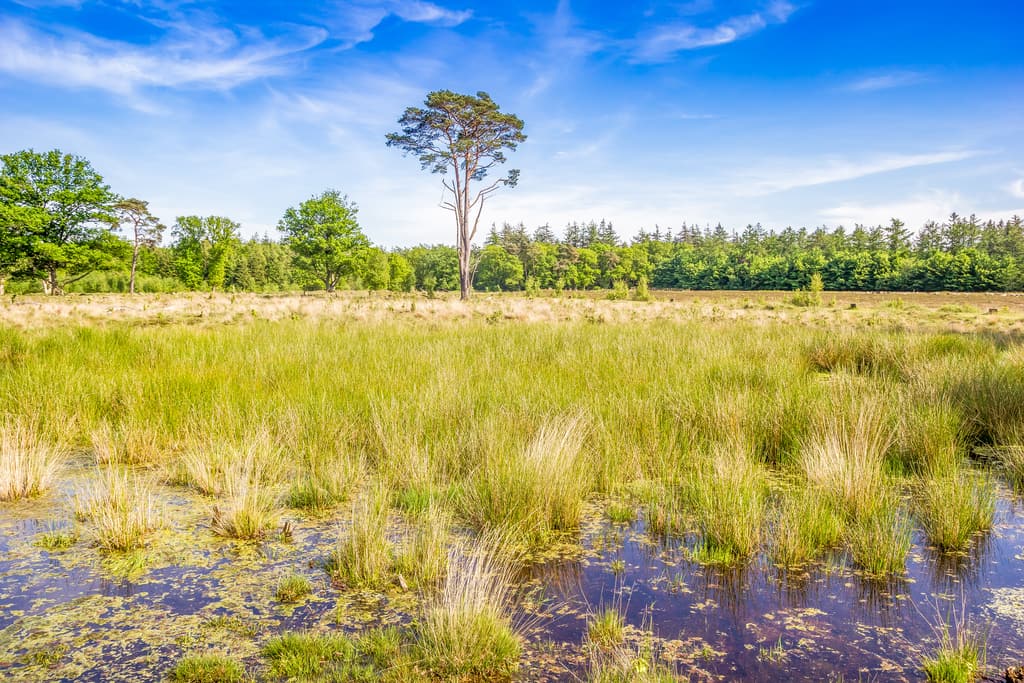
The Balloërveld is a large area of heathland that covers much of central Drentsche Aa National Park. With over 360 acres of terrain, it’s an impressive landscape for sure, but it’s also home to Drenthe province’s largest sheepfold.

Shepherds still drive a flock of around 400 Drenthe Heath sheep around the fields, and an information board at the sheepfold itself is updated daily, telling you where the sheep are currently located. Sometimes it’s a long walk to find them, but it’s definitely always worth it!
Practical info: Schaapskooi Balloo
Address: Crabbeweg 2, 9458 TE Balloo
Opening times: Information Center: daily, from 9 am to 5 pm
4. Hiking and cycling
There’s a lot of great hiking and cycling paths that cross the beautiful landscape here at Drentsche Aa National Park, with options for both short and long journeys and participants of all ages and fitness levels. Near Deurze, you’ll find the Family Path, a short walk through the park that’s entirely paved and level, suitable for prams, scooters, and wheelchairs. Most of the small towns and esdorp villages are the start point for longer walks, so grab a map and head out!
An excellent day option is the 15-kilometre loop walk, covering most of the park’s highlights, starting from Assen. For cycling, there’s several great routes too: kids will love the “silver dagger” route, which runs for 17 kilometres from Eext, while the Rondje Drentsche Aa route for adults is a 32-kilometre loop around the entire park, starting at either Schipborg or the mill in Rolde.
Near the village of Grolloo you can find the longest boardwalk in the Netherlands that crosses the Grollooërveen peat bog.
5. Get a bird’s-eye view of the park
Nothing can be more rewarding than standing on a viewing platform and having a 360-degree view of the area until the horizon. A perfect spot for this in the Drentsche Aa National Park is the Holmers-Halkenbroek viewing tower, located between the areas Holmers and Halkenbroek and Grolloërveen.

The viewing tower is accessible only on foot or by bike, as cars are not allowed in the area, because they interfere with the radio observatory located nearby. See the map above for the exact location.
6. Say ‘hello’ to the birds
Another lovely attraction at the Drentsche Aa National Park is the treetop walkway at Treetop Outdoor Centre (Buitencentrum Boomkroonpad). Walk along the tree tops and enjoy the forest from above. At the centre there’s also a souvenir shop, where you can buy local products, as well, and a cafeteria – Paviljoen de Woudstee, where you can get some refreshments.
Practical info: Buitencentrum Boomkroonpad
Address: Steenhopenweg 4, 9533 PN Drouwen
Admission fee: treetop walkway – adults: 4,50 EUR, kids (4-12 yoa): 2,50 EUR
Opening times: 1 April – 1 November: daily, from 10 am to 5 pm; 1 November – 1 April: Friday-Sunday, from 10 am till 4 pm.
Website: www.staatsbosbeheer.nl (only in Dutch)
7. Visit Camp Westerbork Memorial Centre
Drentsche Aa has also a bit of a dark history attached to it. In the middle of the park, there’s located the former Camp Westerbork. During WW2 Camp Westerbork was a transit camp where Jews, Roma and Sinti, would be first gathered and then sent to concentration camps, like Auschwitz. At the beginning of the war, however, the camp was meant as a refugee camp for the Jews fleeing Hitler’s regime. Between 1945 and 1949, the place served as a military camp, and between 1950 and 1951 as a repatriation camp for Dutch nationals fleeing Indonesia after the War of Independence. Between 1951 and 1971 the indigenous Moluccan KNIL soldiers and their families were kept there and were not allowed to leave the camp.

Today there’s a memorial centre, so that we don’t forget the past and what have happened there.
Practical info: Camp Westerbork Memorial Centre (Herinneringscentrum Kamp Westerbork)
Address: Oosthalen 8, 9414 TG Hooghalen, the camp is about 2,5 km from the museum
Admission fee: Memorial Centre: adults: 10,50 EUR, kids (6-18 yoa): 5,25 EUR; visiting the former camp is free of charge
Opening times: Monday-Friday, from 10 am to 5 pm; Saturday-Sunday, from 10:30 am till 4 pm.
Website: kampwesterbork.nl
Where to stay near Drentsche Aa National Park
The choice of campsites in the Drentsche Aa National Park is overwhelming, from little campsites in the woods, or in lovely farms, to large recreational areas with swimming pools and water parks.
Here’s a small selection of some of the best campsites:
- Camping De Vledders – Zeegserweg 2a, 9469 PL Schipborg
- Campsite De Lente van Drenthe – Houtvester Jansenweg 2, 9462 TB Gasselte
- Bospark Lunsbergen – Rolderstraat 11A, 9531 TC Borger
- Campsite De Hondsrug – Annerweg 3, 9463 TA Eext
- Boscamping-Zwanemeer – Voorste Land 1, 9461 AP Gieten
To see all campsites in the National Park, check out the website of Eurocampings.
Do you love staying in charming B&Bs or holiday homes? Check out these options:
- Bed and Breakfast Gasteren – De Hoek 29, 9466 PC Gasteren
- Bed and Breakfast Annen – Kruisstraat 20, 9468 CM Annen
- B&B Schipborg – Borgweg 8, 9469 PH Zuidlaren
- Aa Casia Holiday Home – Schapedrift 23, 9483 TT Zeegse
- Zeegser Duinen Holiday Homes – 19 Schipborgerweg, 9483 TL Zeegse
- Scheibershof – Hoofdweg 21, 9483 PA Zeegse
If you’d rather prefer hotels, there are both small family hotels and famous large chain hotel to choose from:
- Fletcher Hotel de Zeegser Duinen – Schipborgerweg 8, 9483 TL Zeegse,
- Herberg De Eexter Os – Annerweg 4A, 9463 TA Eext
- Landhuis Hotel Rikus – Hoofdstraat 10, 9463 PC Eext
- Hotel B&B Hoeve de Vredenhof -De Millystraat 15, 9471 AG Zuidlaren
Final words
Overall, Drentsche Aa National Park is one of the more unusual national parks in the Netherlands. With its focus on unique cultural historic (and a side helping of beautiful landscapes!), it’s truly one of the most fascinating and interesting national parks in the entire country. Drentsche Aa National Park is well worth a visit and should be top of the list for all visitors to Drenthe.
Do you need some extra help to plan your trip to the Netherlands? Join the dedicated Exploring the Netherlands Facebook Group, where you can get tips from other travellers and locals. Or perhaps you have questions or comments? Join the group and I’ll be happy to answer them.
