

Dwingelderveld National Park is an interesting and beautiful national park, located in the northern Netherlands. Mostly consisting of wet moorlands and heathlands, Dwingelderveld is one of the largest such areas in western Europe, and as you’d expect, it’s packed full of fascinating plants, animals, and ecosystems. Let’s take a closer look.
TRIVIA:
❒ Official name: Dwingelderveld National Park (Nationaal Park Dwingelderveld)
❒ Established: 1991
❒ Size: 3700 ha
❒ Location: Drenthe
DISCLOSURE: This post contains affiliate links. If you make a purchase via one of those links, I will earn a commission at no extra cost for you.
About Dwingelderveld National Park
Dwingelderveld is about 37 square kilometres in size and sits in the south-west of Drenthe province. It’s about an hour’s drive south of Groningen, while the towns of Hoogeveen and Assen are quite close by. Its modest size ranks it among the smaller national parks in the Netherlands, but at the same time it’s still packed with interesting stuff!
Humans have lived in the Dwingelderveld National Park area for thousands of years. Burial mounds and other ancient remains can still be seen dotted around the landscape, but poor soil quality and layers of sand meant that the Dwingelderveld area was never heavily exploited by farmers or herdsmen. Proposals to drain and reclaim the area were launched in the 1930s, but the plans never eventuated, and Dwingelderveld National Park was officially gazetted in 1991, one of the earliest parks in the Netherlands. It’s jointly managed by the Dutch Forestry Service (Staatsbosbeheer), and Natuurmonumenten, a private nature conservation group.

Most of the terrain at Dwingelderveld National Park consists of wet heathlands, along with peat bogs, swamps, marshlands, and some sand drifts too. There are also small areas of forest, and the Netherlands’ largest juniper thicket, so it’s quite a fascinating area to explore.
As you’d expect from an interesting environment like Dwingelderveld National Park, animals can be found here in abundance. Deer are quite a common sight in the forested areas, while birds of prey, cranes, and woodpeckers keep the bird-watchers busy. Many butterflies also live in the park, particularly during spring and summer, and it’s also one of the few places in the Netherlands where the poisonous adder snake can be found. It’s the only known poisonous snake species in the Netherlands, but it generally ignores humans unless provoked or threatened – so don’t worry about it too much!
How to get to the Dwingelderveld National Park
The park is located close to Hoogeveen and at a very short ride from Assen. This national park is easily accessible by car, as it lies along highway A28. You can park conveniently just outside the park and explore it further on foot, on bike or horse. Check out the map for the parking places around the park.
Read more: If you decide to stay longer in Drenthe, check out this 3-day itinerary in Drenthe.
Ruinen and Dwingeloo are two of the towns with an easy access to the park. Here are some distances to these places from a few major cities in the Netherlands:
- Groningen – Dwingeloo: 60 km/50 min; Groningen – Ruinen: 65 km/50 min;
- Leeuwarden – Dwingeloo: 70 km/55 min; Leeuwarden – Ruinen: 80 km/1 hr;
- Amsterdam – Dwingeloo: 140 km/1 hr 50 min; Amsterdam – Ruinen: 135 km/1 hr 50 min;
- Eindhoven – Dwingeloo: 200 km/2 hrs 10 min; Eindhoven – Ruinen: 190 km/2 hrs 5 min;
- Rotterdam – Dwingeloo: 190 km/2 hrs 15 min; Rotterdam – Ruinen: 185 km/2 hrs 10 min;
- Maastricht – Dwingeloo: 280 km/3 hrs 10 min; Maastricht – Ruinen: 270 km/3 hrs.

Unfortunately, the park is not easily accessible by public transport, of course it depends on where exactly you are located. To get to Dwingelderveld National Park from Amsterdam, it takes about two and a half hours. You first need to take the train to Meppel and then bus line 32 to Hoogeveen via Ruinen. Bus line 47 between Meppel and Hoogeveen stops near the Visitors Centre in Ruinen (bus stop Ruinen). It’s a 2,5 km walk from Ruinen to the Visitors Centre.
Tip: Read this post about using the public transport in the Netherlands. It’s packed with tips that only a local knows!
Facilities in Dwingelderveld National Park
Save this map to MyMaps on Google, so that you can easily and quickly find all important places at the Dwingelderveld National Park.
Visitors Centre Dwingelderveld
The main visitors centre at Dwingelderveld National Park is the Visitors Centre Dwingelderveld (Dutch: Bezoekerscentrum Dwingelderveld), located just near the village of Ruinen on the park’s southwestern boundary. The centre hosts a permanent exhibition on the heathland environment inside the park and the area’s history, plus there are temporary exhibitions on a variety of topics.
It’s definitely worth starting your visit to Dwingelderveld at the Visitors Centre, as most of the walking and cycling trails start from this point. It’s also where guided tours depart from, so if you’re doing a ranger guided walk or a specific activity, this is where you’ll need to be. There’s also a small shop on site, selling maps, brochures, souvenirs, books, snacks, and drinks. And while you’re there, be sure to check out the nearby butterfly garden, bee colony, and the insect hotel as well.
Practical info: Bezoekerscentrum Dwingelderveld
Address: Benderse 22, 7963 RA Ruinen
Opening times: Wednesday-Sunday, from 10 am till 5 pm
De Boslounge in Spier
Another, smaller visitor’s centre is located at the eastern edge of the park, at the Spier Gate (Natuurpoort Spier). De Boslounge Spier is the former information centre and has since been converted into a café and a large kids’ playground. Visitor information is still available here, and there’s an excellent paved walking trail from here, known as the Familiepad, that’s suitable for all ages and mobility levels.
Practical info: De Boslounge
Address: Oude Postweg 8, 9417TG Spier
Opening times: April-October: daily, from 10 am till 5 pm, November-March: Saturday-Sunday, from 10 am till 5 pm
Things to do at Dwingelderveld National Park
Now that we’ve learned about Dwingelderveld National Park, and discovered the information centre, let’s have a closer look at the activities and other things to do in the area.
1. Hit the hiking trails
There’s plenty of excellent hiking trails in the national park, with everything from relaxed strolls to serious scrambles. As mentioned above, the Familiepad is a short 2.5-kilometre loop from the Spier Nature Gate, running through beautiful heathlands and dotted with picnic benches. It’s fully paved and well maintained, making it fully accessible for wheelchair and walker users.

Hiking route Lheederzand explores the drifting sands, while hiking trail Witteveen meanders through the flowering juniper thickets. There’s a 13-kilometre Nordic hiking trail, with some genuine cross-country sections, or the super-athletic can tackle the 23-kilometre trail run that circles the park.
2. Do some cycling
Dwingelderveld National Park is covered in tens of kilometres of cycling routes as well. The main route is around 30 kilometres, and loops around most of the key points of interest in the park. Although it officially starts and ends at the visitors’ centre, you can start and finish at any point along the route – or take a shortcut if you’d prefer! Another interesting option is the Dutch Landscape Masterpiece audio cycling tour, delivered via a phone app. Cruise around the landscape on your bike, while listening to the app’s commentary about local history, and how Dwingelderveld’s beauty has inspired several Dutch master painters over the years.
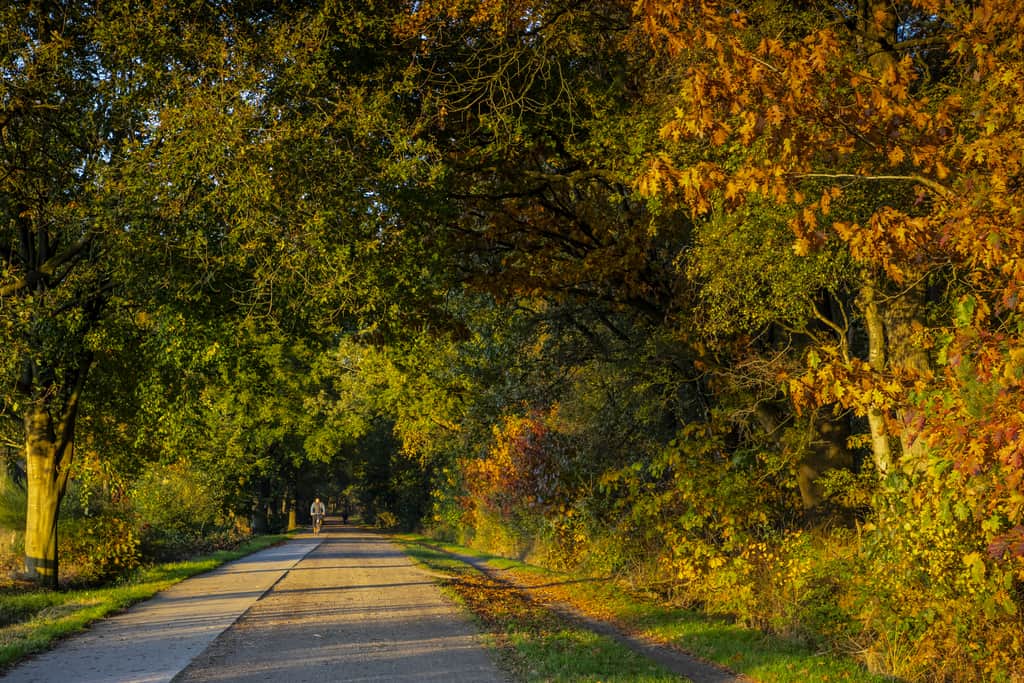
If you don’t have your own bike, don’t stress! There are plenty of bike hire operations at the nearby towns and villages. Here are some places where you can hire a bike:
- Reiber Rijwielen – Brink 24, 7991CH Dwingeloo
- RCN de Noordster – De Noordster 105, 7991 PB Dwingeloo
- EuroParcs Ruinen – Oude Benderseweg 117963 PX Ruinen
Most of the accommodation in the area also offer various types of bikes, from e-bikes to mountain bikes.
3. Count the sheep
Another popular thing to do at this National Park is sheep-watching. Yep! Just as you can watch birds, you can watch sheep. There are 2 sheep flocks in the park herded by shepherds: Schaapskudde Achter ‘t Zaand, also known as Dwingelder schaapskudde Lhee, and Schaapskudde van Ruinen. You can watch how the sheep are taken from the sheepfold and brought to the heathlands to graze.
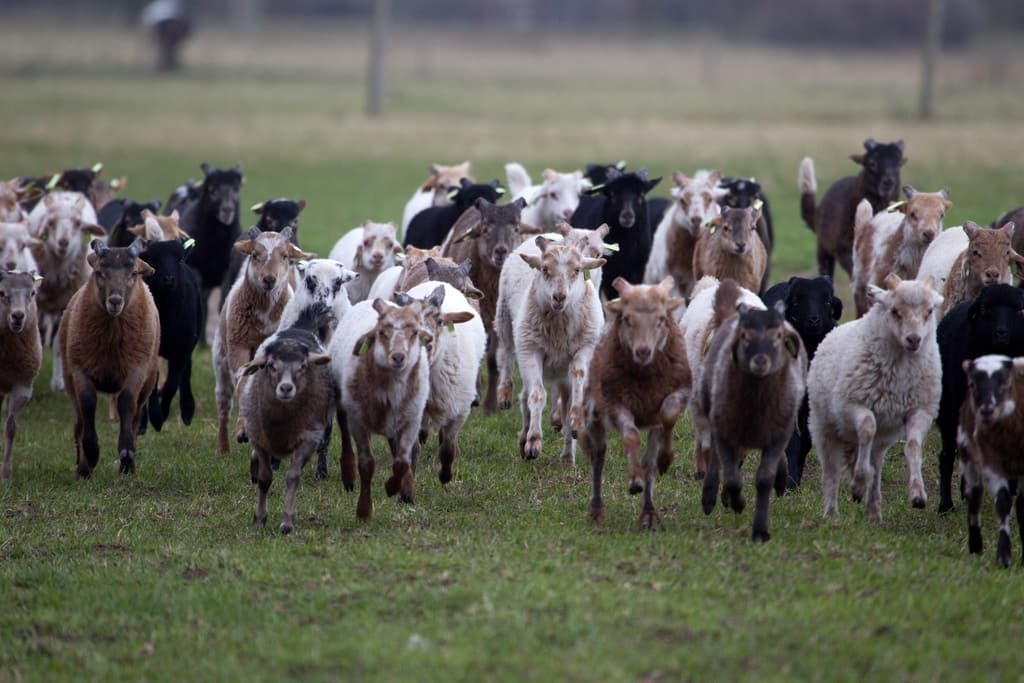
The sheep are a local breed – the Drenthe Heath Sheep (Drents heideschaap), from which there are only about a few thousand today. In the 1970s there were only 100 of them left! The shepherded sheep flocks in Drenthe have the status of immaterial cultural heritage in the Netherlands.
Practical info: Schaapskudde Achter ‘t Zaand
Address: Achter ‘t Zaand 4, 7963 RA Dwingeloo
Opening times: The information centre is open on Sundays in winter: from 1 pm till 5 pm, in the summer: 11 am till 5 pm
Practical info: De schaapskooi van Ruinen
Address: Benderse 26, 7963 RA Ruinen, near the Visitors Centre
4. Go birdwatching
Dwingelderveld is also a popular destination for the birdwatchers. You can spot there buzzards, sparrow hawks, hawks, hobbies, kestrels, and honey buzzards. In the winter season you can see there hen harriers, merlins (stone falcons), peregrine falcons, and rough-legged buzzards. The crane can also be spotted quite often in the park.

If you love birdwatching and bird spotting, then the bird-watching hut at the Davidplassen is one of the places where you can hide and wait to spot the birds. From here there’s a super lovely view over the lakes. Further in the area, on the cycle path along the Holtveen, there is a bird observation wall. Through the hatches on the wall, you can watch the special swamp birds.
Check out the map above for the exact locations of the birdwatching places.
5. Go horseback riding
Several equestrian trails have been established through the national park, separate from the walking and cycling paths. These are of varying lengths and are suitable for both horse riding and horse & cart combinations. Note that sheep are still actively grazed in parts of the park, so ride slowly and treat them respectfully. It’s also forbidden to water horses at the edges of peat bogs, due to the risk of trampling fragile plants.
6. Marvel the Dwingeloo Radio Telescope
Unusually, Dwingelderveld National Park is home to a radio telescope! Officially known as the Dwingeloo Radio Telescope, it was the world’s largest when built in the 1950s, but was decommissioned by 2000 and converted into a national monument.
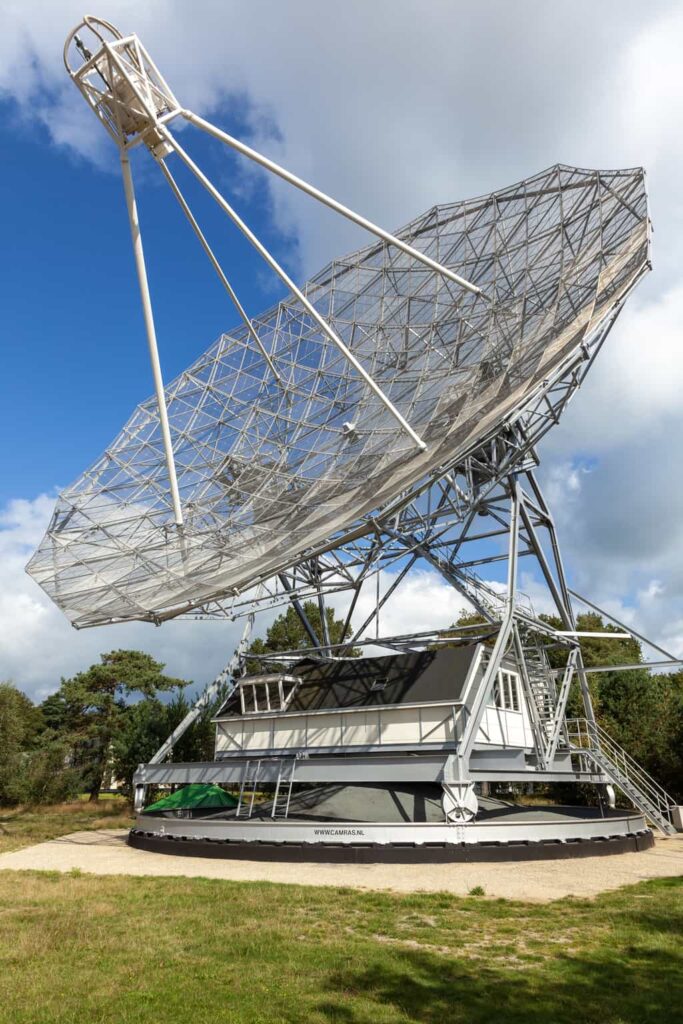
These days it’s home to ASTRON, the Netherlands Institute for Radio Astronomy, and is open to the public (though only on open days, and bookings are required). But you can still see it from outside! It’s quite impressive with its diameter of 25 m. There are also information boards with tons of interesting facts about the telescope and the area.
Practical info: Dwingeloo Radiotelescoop
Address: visitors via Oude Hoogeveensedijk 6, 7991 PD Dwingeloo; information boards are on the Davidshoeve bicycle path
Entrance fee: adults – 5 EUR, kids and youth (6-24 yoa) – 2.5 EUR
Opening times: Only on special occasions or with a booking. In 2022 the dates are: 12 March, 11 September, 2 October, 29 October. More dates are published on the website: www.camras.nl (available only in Dutch)
7. Get a bird’s-eye view of the area
There are two observation towers in the area from where you can have some lovely views of the National Park. One observation tower is very close to the Ruiner sheepfold. Located on a small hill (at 3 m above sea level), this 6m high tower is a must-visit in Dwingelderveld.
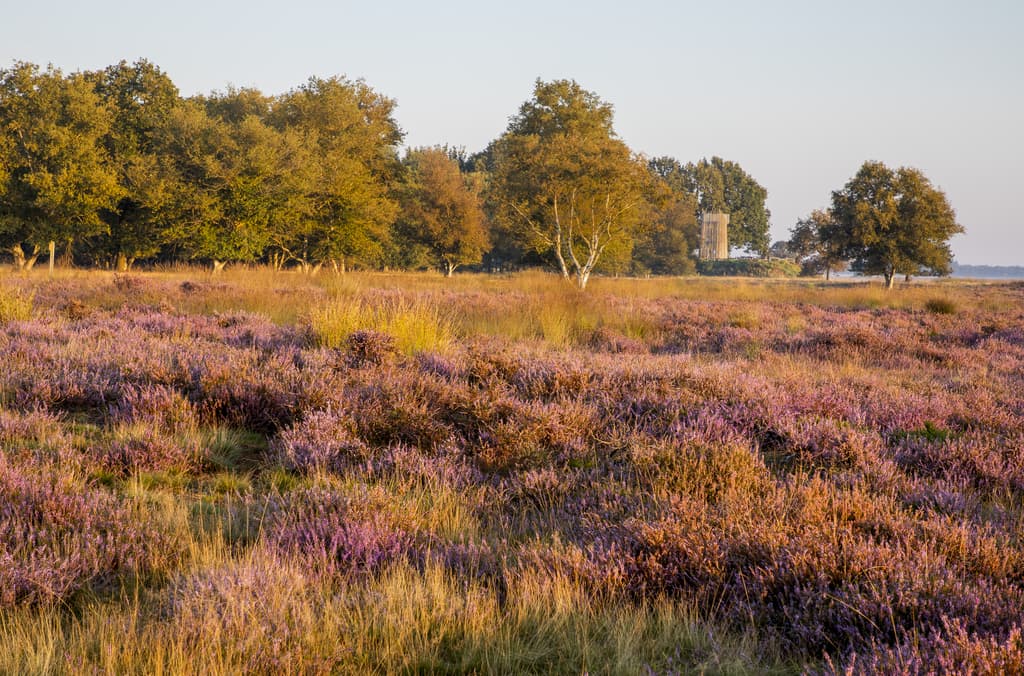
The other one is the observation platform Schapenkop ‘De Keep‘ (Sheepshead ‘De Keep’). On one side you can watch the traffic on A28 and on the other – the beautiful nature. The large artwork of a sheephead is the symbol of the National Park and represent a head of the local Drenthe Heath Sheep breed.
Check out the map above for the exact locations of the towers.
8. Check out the little villages
This part of the Drenthe province is famous for the so-called esdorp landscape. ‘Esdorp‘ are villages that have developed around a village green during the Middle Ages. The structure of the esdorp is recognizable in Ruinen, Lhee, Dwingeloo, Ansen, and Kraloo.
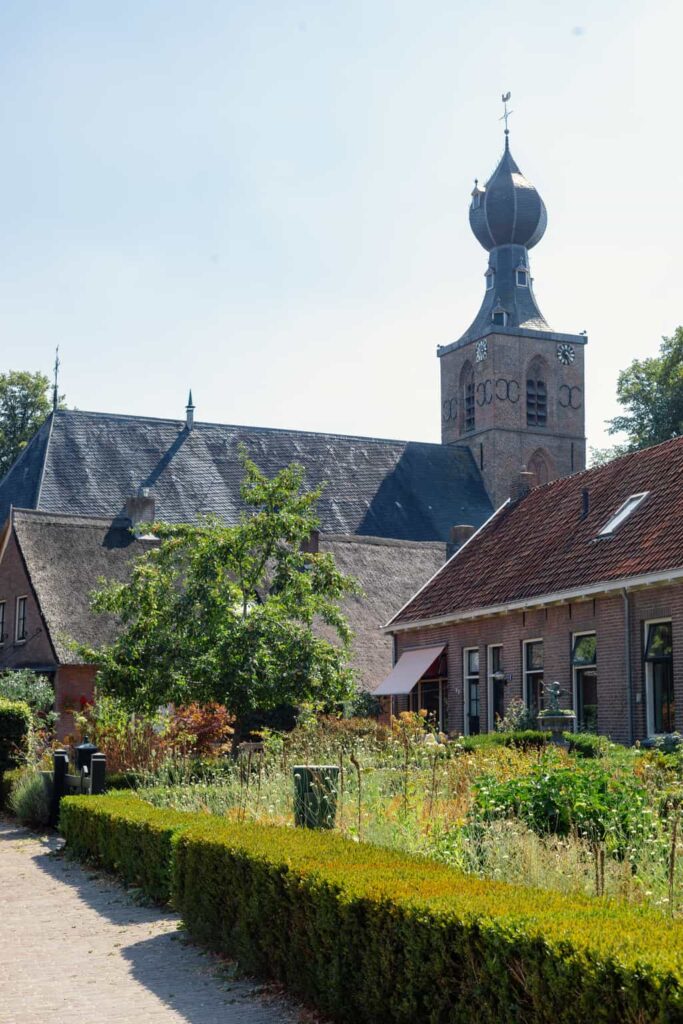
And there are also the so-called ‘brinkdorp‘ where the village green, quite often shaded by trees, had a different function. The cattle from the village would gather there before it would be taken to the nearby pastures. Beautiful village greens can be found today in Dwingeloo, Ruinen and Lhee.
Where to stay near Dwingelderveld National Park
There’s plenty of places to camp out overnight in Dwingelderveld National Park, including well equipped campgrounds scattered throughout the area. There are no hotels within the national park area, but there’s plenty of excellent options in the villages and towns adjacent to the park, including Dwingeloo, Spier, Lhee, and Ruinen.
Campsites:
- Natuurcamping De Olde Bârgen – Oude Hoogeveensedijk 1, 7991 PD Dwingeloo
- d’Olde Kamp – Dwingelerweg 26, 7964 KK Ansen
- Camping Meistershof – Lheebroek 33, 7991 PM Dwingeloo
Holiday parks – suitable for a longer stay, for example if you want to spend your holidays near the national park:
- EuroParcs Ruinen – Oude Benderseweg 117963 PX Ruinen
- RCN de Noordster – De Noordster 105, 7991 PB Dwingeloo
Bed & Breakfast – ideal for a hassle-free long-weekend or a mid-week experience:
- B&B de Ster van Dwingeloo – Heuvelenweg 8, 7991 CK Dwingeloo
- B&B de Sfeerhoeve – Smalbroek 42, 9411 TV Beilen
- B&B Altijd Welkom – 21 Benderse Vrijstaand huis, 7963 RA Ruinen
- B&B An de Kraloërweg – Kraloërweg 3, 7935 AA Eursinge
- De Anselier – Om de Kamp 8, 7964 KT Ansen
- The Teaspoon – Westeinde 29, 7991 RS Dwingeloo
- De Beddestee – Bos 5, 7963 SG Ruinen
- B&B De Achterdiek – Ruinerveldweg 1, 7963 PL Ruinen
- B&B De Meidoornhof – Westerstraat 55, 7963 BB Ruinen
Hotels – if you don’t want to miss on comfort:
- Hotel van der Valk Spier Dwingeloo – Oude Postweg 8, 9417 TG Spier
- Fletcher Hotel-Restaurant de Borken – Lhee 76, 7991 PJ Dwingeloo – with an indoor swimming pool and a sauna
- Boutique Hotel de Drentse Liefde – Drift 4, 7991 AA Dwingeloo
- Hotel De Stobbe – Westerstraat 84, 7963 BE Ruinen – with an indoor swimming pool and a sauna
- Hotel Kuik – Brink 15, 7963 AA Ruinen
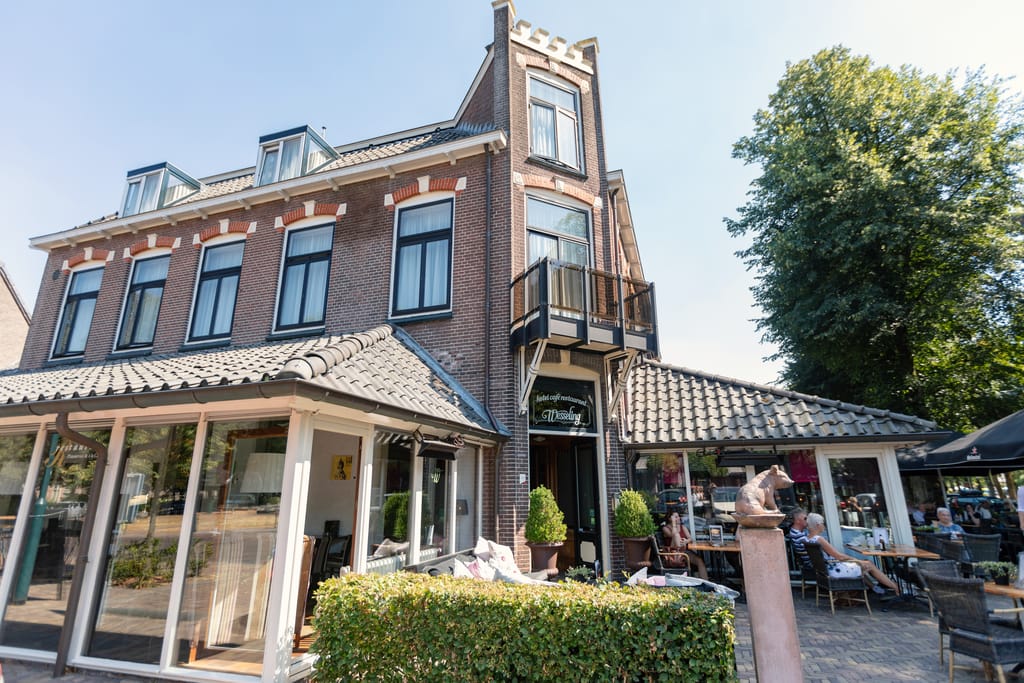
- Hotel & Restaurant Wesseling – Brink 26, 7991 CH Dwingeloo
Holiday homes – perfect for a longer stay:
- Rheelanden – Dwingelerweg 26, 7964 KJ Ansen
- Grandeur Farmhouse in Dwingeloo at a National Park – 7991 PE Dwingeloo
- An de Esch – Westeinde 31, 7991 RT Dwingeloo
Final words
All up, Dwingelderveld National Park is a beautiful place to explore, with its fascinating and unique environment. There’s plenty of things to see and do here, and this Drenthe national park should be near the top of everyone’s list when visiting the area.
Do you need some extra help to plan your trip to the Netherlands? Join the dedicated Exploring the Netherlands Facebook Group, where you can get tips from other travellers and locals. Or perhaps you have questions or comments? Join the group and I’ll be happy to answer them.
