

UNESCO World Heritage Sites don’t need to be mesmerizing or grand, as long as they are of great outstanding value for the humanity. One such site is the Eisinga Planetarium in Franeker. Designed by an amateur astronomer and located in the living room of a typical Dutch house along a canal, this planetarium is the oldest still working planetarium in the world. Read further to find out what makes the Franeker planetarium so special and how to visit it.
TRIVIA:
❒ Official name: Eisinga Planetarium in Franeker
❒ Date of inscription: 2023
❒ Reference number: 1683
Did you know that the Netherlands is a home to 13 World Heritage Sites? Curious which they are? Read this:
➭ The 13 UNESCO World Heritage Sites in the Netherlands
DISCLOSURE: This post contains affiliate links. If you make a purchase via one of those links, I will earn a commission at no extra cost for you.

What is the Eisinga Planetarium?
The Eisinga Planetarium, also known as the Eise Eisinga Planetarium is a historic planetarium that was built in the late 18th century by Eise Eisinga, a Dutch amateur astronomer and mathematician. The planetarium is unique because it is a working model of the solar system, with intricate mechanical movements that accurately depict the positions and movements of celestial bodies, including the planets and the Moon. It’s considered one of the oldest functioning planetariums in the world.
History of the Eisinga Planetarium
Eisinga’s motivation for building the planetarium was to counter the public panic caused by a prediction that a planetary alignment would lead to a catastrophic event, including the end of the world. He built the planetarium to demonstrate that such fears were unfounded and to educate people about the true nature of the cosmos.
In April 1774 an article appeared in a local newspaper in Leeuwaarden, written by Eelco Alta, a pastor from Bozum. He predicted that on 8 May 1774 a special conjunction of planets would take place. Mercury, Venus, Mars, Jupiter and the moon would be so close together that the mutual forces of these celestial bodies would throw the Earth out of its orbit and burn it up in the sun, a true Armageddon. This article caused a lot of unrest among the people and the authorities even tried to intervene by banning the writing, but it didn’t help.

So Eise Eisinga decided to built an orrery to prove that nothing like this would happen. He started building the model of the solar system with all celestial bodies on the ceiling of his living room in the house Franeker. The project was finished in 1781, a year before Uranus was officially discovered as a planet. So, that’s why you can see there only the Sun, the Moon, the Earth and the five other planets known then: Mercury, Venus, Mars, Jupiter and Saturn.
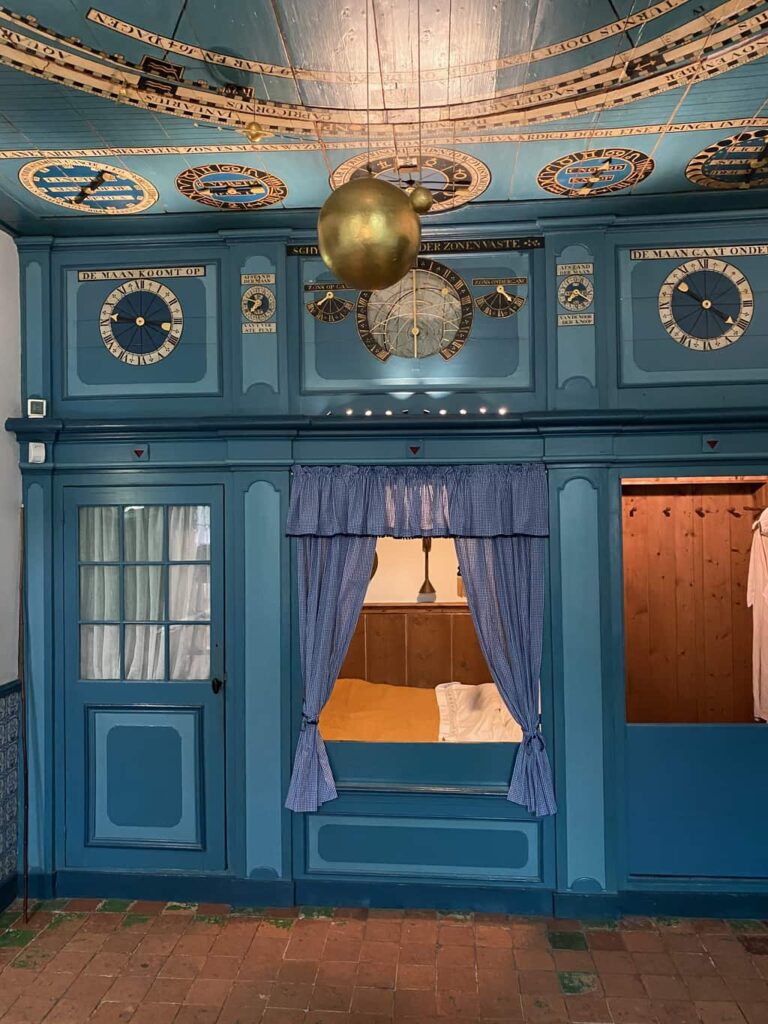
In 1818 King Willem I visited the planetarium and was so impressed that he bought it in 1825 for the country. In 1859 the planetarium was given back to the city of Franeker and it was turned into a museum. As of 1967 the Royal Eise Eisinga Planetarium in Franeker was included in the Top 100 Dutch Heritage Sites (a listing that does not exist anymore) and since 2023 it is enlisted as a UNESCO World Heritage Site.
Who was Eise Eisinga?
Eise Eisinga (1744–1828) was born in Dronrijp, a small village in the province of Friesland but he spent much of his life in Franeker, also in Friesland. As a kid he started working at the wool combing shop of his father which he further developed into a very profitable business with 400 employees.
Eise Eisinga was a self-taught scholar with a keen interest in astronomy and mathematics, a typical representative of The Enlightenment. As an autodidact he was part of what today is known as ‘boerenprofessor‘, that literally translates to “farmer professor” in English. These self-taught experts didn’t attend Universities and didn’t get any degrees, and still they possessed knowledge to build orreries and telescopes. This trend was quite popular in Friesland throughout the 18th and 19th centuries, where Eisinga comes from.

This wasn’t a coincidence as there used to be a University in Franeker (University of Franeker, 1585–1811), which was the second oldest University in the Netherlands after the University of Leiden. Although the University’s official curriculum was taught in Latin, there were also materials in the common Dutch language for the laymen.
Eisinga was also politically quite involved. As a supporter of the Patriots he had to flee Franeker in 1787. After some time spent in Germany he returned to Visvliet in Groningen. In 1791 he was extradited and sentenced to 5 years in exile from Friesland. He returned in Franeker in 1795 following the revolution in 1795, that led to the formation of the Batavian Republic (1795-1806).
How does the Eisinga Planetarium work?
The mechanism in the Eisinga Planetarium is an intricate and ingenious system of gears, pulleys, and weights that simulates the movement of celestial bodies in our solar system. Its central pendulum clock is driven by 9 weights. This clock regulates each planet’s correct orbital speed via a gear mechanism consisting of wooden hoops and discs, and featuring 5934 hand-forged nails as cogs. The speed at which the planets of the planetarium move around the Sun is the same as that of the real ones. Here’s a simplified overview of how it works:

- Earth’s Rotation: The central feature of the planetarium represents the Earth. It rotates on its axis once every 24 hours, simulating the Earth’s daily rotation.
- Orbits of the Planets: Small spheres representing the planets (Mercury, Venus, Mars, Jupiter, and Saturn) are mounted on rods that radiate from the central Earth model. These rods are connected to gears and are positioned at the correct angles to represent the planets’ orbits around the Sun.
- Gearing System: The gears connected to the Earth’s rotation drive the planetary orbits. As the Earth model rotates, it turns the gears that, in turn, move the rods with the planet models. The gear ratios are carefully calculated to ensure that the planets move at the correct relative speeds.
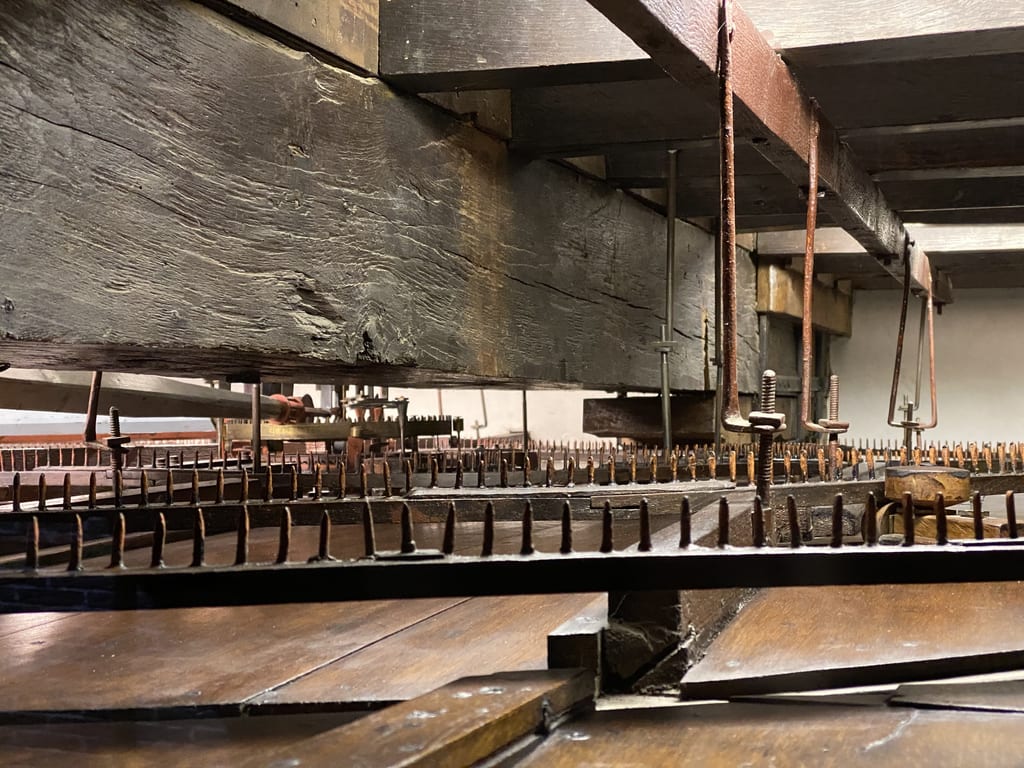
- Manual Adjustments: Eise Eisinga designed the planetarium to be manually adjustable to account for variations in planetary positions due to their elliptical orbits. He made adjustments by turning cranks to change the positions of the planet models, keeping them accurate over time.
- Moon and Other Features: The mechanism also includes a representation of the Moon and various dials and indicators for tracking the positions of celestial bodies, the date, and other astronomical information.

In his will Eisinga described how the planetarium works and he left instructions how to manually reset the mechanism to compensate for a leap day, for example. To this very day, the planetarium shows the current positions of the planets.
How to visit the Eisinga Planetarium?
The Royal Eise Eisinga Planetarium is located in Franeker, in the province of Friesland. From Amsterdam it takes about 1 hr 30 min by car to get to Franeker and between 2 hr 30 and 3 hr 30 min by public transport. If you are already in Franeker, the museum is located in the city centre, just a short walk from the train station.

Tip: Read this post about using the public transport in the Netherlands. It’s packed with tips that only a local knows!
Practical info
Address: Eise Eisingastraat 3, 8801 KE Franeker
Admission fee: adults – 6 EUR, kids (4-13 yoa) – 5 EUR
Opening times: Tuesday-Saturday, from 10 am till 5 pm; Sunday, from 11 am till 5 pm; 1 April – 31 October, open also on Mondays, from 11 am till 5 pm
Website: www.eisinga-planetarium.nl
Final words
Overall, the Eisinga Planetarium’s mechanism is a remarkable example of 18th-century craftsmanship and scientific understanding. It provides a visual and mechanical demonstration of the relative movements of the planets and other celestial objects within our solar system.
Do you need some extra help to plan your trip to the Netherlands? Join the dedicated Exploring the Netherlands Facebook Group, where you can get tips from other travellers and locals. Or perhaps you have questions or comments? Join the group and I’ll be happy to answer them.
